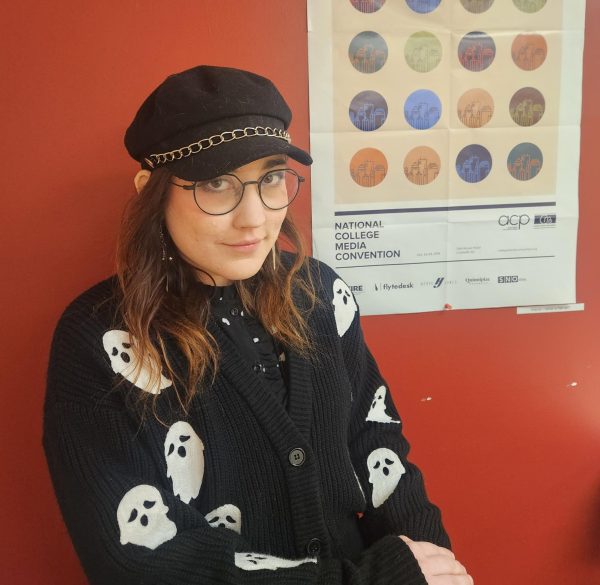


On Nov. 8, 2025, Psychology student Blys Brinkley presented her research on corrective feedback in Japanese language learning at the Georgia Undergraduate Research Conference (GURC) at Emory University, Oxford. Corrective feedback, Brinkley explained, is simply telling a learner out loud whether they are correct and repeating the correct answer. Brinkley has conducted this research for the past three years. While she encourages current students to get involved in research, she acknowledges some of the challenges the department is facing in terms of its ability to offer diverse research experiences.
“We were measuring known symbols and words for the individuals,” Brinkley stated during her presentation at the conference. “We had forty randomized trials where these were presented to participants. Participants were able to guess the correct answers or say ‘I don’t know’ and move onto the next trial.” Brinkley explained that participants were either offered a vocal response of “correct” for correct answers or had the correct answer repeated to them when they got the question right.
Her results reflected that repeating the answer did not change the number of trials needed to learn the words. However, she did note that words were more easily remembered than symbols for both groups. She also mentioned the existing research gap on vocal feedback in learning settings compared to written feedback. Brinkley met with The Uproar to discuss her experience conducting independent research at Columbus State while still working and attending classes.
“That was the only semester I think I’ve ever had an actual hard time completing,” Brinkley stated in reflection on the final semester of her undergraduate degree. She was a Psi Chi officer, the treasurer of the psychology club, and held down two jobs while getting ready for GURC and applying to graduate programs. “It was very hard to manage time, really, I just cut out a lot of stuff. It’s really about sacrifice. I didn’t really do any of my hobbies…I was just grinding the whole semester.”
The conversation then turned to future research endeavors. The research Brinkley presented at GURC was originally inspired by a study of Dr. Stephanie Da Silva’s, for which Brinkley collected control data. The implementation of vocal corrective feedback was an effort by Brinkley to see if there was a way to speed up mastery of Japanese words and symbols. Despite her current work at The Brain Center and her experience with behavioral research, Brinkley is currently focused on clinical subfields. Her current study relates to Event Related Potentials (ERP), or condensed versions of EEGs.
“I specifically would like to be a clinical psychologist, focusing on individuals and groups with anxiety disorders,” Brinkley stated about her career goals. While the conversation was generally optimistic about Brinkley’s successes, she also spoke about the challenges facing Psychology students who want to do studies of their own. “I have a lot of students come up to me, you know, and ask, how can I get into research? Sometimes in my sessions, they’re like, how can I do this? But then I’d have to tell them, oh, well, Dr. Schmidt is retired. He’s leaving so that completely takes out any neurological study they want to do. Da Silva’s going on sabbatical for a year, so that takes out most behavior analysis.”
She spoke about how Columbus State’s Psychology Department has faced significant challenges post-COVID with funding and staffing. The current department chair, Jeremy Newton, was hired last Spring. Two professors, Dr. Aisha Adams and Dr. Tiffany Berzins, accepted positions at other universities that same semester. The department recently welcomed three new faculty members: Dr. Rebecca Dunterman, Dr. Jasmine Betties, and Dr. Elizabeth Smith. They have also rebooted their Psi Chi chapter. Two current students are attempting to get Dr. Da Silva’s rat lab up and running again as a part of the department’s continued efforts to give students more research opportunities.
“It’s a problem with funding. We just don’t have the resources, the faculty, or really the student motivation to do it, and we need all of that combined,” Brinkley stated. However, she emphasized ways current students can take initiative when looking into conducting independent studies of their own. “A lot of students kind of wait for the opportunity to hear about a lab and then try joining it…and people also have to be willing to do research that they’re not really interested in as well. A lot of people only want to do their niche, and you can’t do that in undergrad…you have to be willing to work with various professors on their topics.”
Brinkley has since graduated summa cum laude and is currently tutoring and working at the Brain Center while waiting to hear back from various clinical graduate programs.