

We here at The Uproar are often very busy. Between writing articles and keeping up with our actual classes, it can be difficult to find time to get a quick bite to eat. That’s where Columbus State Dining Services comes in. We interviewed Arlando Sneed, the head chef for both dining halls, to ask him what makes working here different from other kitchens, what challenges and complaints the dining hall has faced over the years, and how dining services has improved over the course of his career. It turns out that there’s far more heart, soul, and thought that goes into our food than some students realize.
“So, when did you get started in kitchens?”
“I started in the kitchen in about 2009 at a hibachi restaurant.” Arlando reminisces about Shogun, a now defunct sushi and hibachi restaurant. “I was a washoku chef. I just did to-go orders and sushi bar orders. I started in this kitchen in about 2013.”
We asked Chef Sneed if he ever had any formal training, such as culinary school. He stated he was self-taught. We conversed about the hit-or-miss nature of culinary training.
“What I’ve learned about a lot of culinary students is culinary school don’t teach you how to cook. They teach you how to cut, they teach you names of different cuts, they teach you the base sauces…they don’t teach you how to cook.” He went on to talk about former employees who did receive formal training. “I’ve had a few chefs work for me from culinary school and they were trash.”
He was not, however, entirely against the concept of formal training. “It is valuable,” he said, “I always say you can never have enough knowledge. I would go myself if I could, just to learn whatever they teach them. I already know how to cook.”
“I’ve always said that the cafeteria is the restaurant job for chefs who care about people. What made you choose cafeteria over fine dining or work as a private chef?”
“Once I started working here, I never looked back to the restaurant industry. It’s a different pace; that’s the main thing. Here, you kind of work on your own pace. You can get ahead and stay ahead.” Chef Sneed almost seemed exhausted just thinking about his restaurant days. He continued, “With restaurant it’s always seat to eat. You’re really cooking to order. After a while, you get burned out on that.”
Turning the conversation back to CSU Dining, he said, “This is actually an easy job. You can learn a lot from this. Whatever you learn you can take wherever you go.”
It makes sense that chefs learn quite a bit in a cafeteria setting. The menu changes fairly regularly. There are multiple stations offering various types of cuisine, all of which offer developing chefs transferrable skills. Newer chefs can add hibachi skills to their resume if they’re working the grill at the global kitchen. They can add dough management and prep if they happen to be making pizza. All workers get experience with prepping and serving massive amounts of buffet-style food, an essential skill for anyone wanting to get into catering.
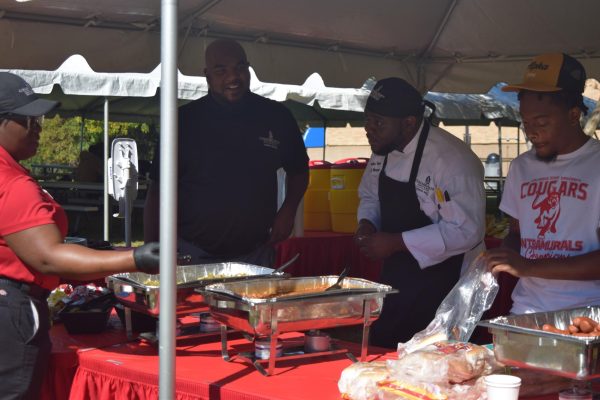
Sneed echoes this when discussing his role on campus with catering. Chef Sneed supervises and plans all catered events on campus, from the walking tacos served at the Clocktower for Interfaith Fair to large charity events with open bars.
“We do custom menus. So, whatever you request, if you request lamb chops or lobster tail, as long as your budget fits it we make it.”
Any readers who have attended an event on campus with catering have probably seen Chef Sneed hard at work. This is not something most chefs necessarily get when they’re working in a restaurant.
“You get more face time with the people eating your food than most chefs do. There’s not really that separation between front of house and back of house. Is that ever challenging for you or your staff? Or does that make the job more rewarding?”
“Interacting with you guys? That’s always better” Chef Sneed answered. “I want people to come put in requests, complaints, everything. If we don’t know, we can’t fix it. So no, it’s not challenging.”
We talked about how being in a restaurant kitchen receiving complaints secondhand through the servers sending the food back can really get under a chef’s skin. When someone sends food back at a restaurant, they aren’t usually belligerent about it. Perhaps their steak wasn’t temped correctly, or perhaps they asked for Swiss cheese instead of pepperjack. Most people will shyly mention it to the server or even apologize for sending the incorrect order back. However, if the server is stressed out that day or already angry with the back of house staff, that gentle complaint may get communicated in an aggressive or abusive manner.
When it comes to complaints from CSU students, Sneed states that staff is supposed to find a higher-up like himself in the event of a complaint.
We also asked about how CSU’s kitchen has changed and adapted in response to various criticisms over the years. Dietary restrictions, healthier options and portion sizes, and a more limited menu downtown have all been frequent points of contention.
“Let me tell you about those complaints,” Sneed says, “When [students] put in those complaints, they go to corporate. Corporate always tells us to change something, to fix it. We always try to have something for the vegetarians, for the vegans. Honestly, I think there are options, maybe not options they like, but we have a full salad bar. Even with [the Mongolian grill] they can have everything over there except the protein. It’s cooked with oil, so it’s still vegan. Over at the hotline, we do a vegetarian and vegan dish every day. We have veggie burgers at the grill.”
We mentioned that a lot of the complaints about dietary restrictions come from the Rankin. For those who only eat on main campus, the Rankin dining hall has very limited space. “We’ve always had that issue with the Rankin.” Chef Sneed agrees. We also pointed out that if the Rankin were to offer more options for students, they would essentially need to curate their entire menu to vegans, vegetarians, and students with food allergies. “[Aramark] has a station like that at a lot of other campuses. We don’t have that here.”
We mutually reached the conclusion that it is CSU’s responsibility to ensure that diners on both campuses have the same number of options available to them. “I will mention that, you know, CSU; they listen to the students better than they listen to us. We can request something, but when the students request something, then it kind of happens. If students do run across issues here, whoever they’re dealing with is not the right person. They just gotta find the right person to deal with. We can probably fix any situation.”
We can attest to the fact that the dining hall does handle certain complaints rather well, especially in the case of dietary needs. Earlier in the semester, this reporter was unable to change their meal plan to a commuter plan after deciding not to live in the dorms. Due to medical reasons and a jam-packed schedule, the ability to swipe into the dining hall was somewhat of a necessity. Cougar Café was very understanding and provided this reporter with some coupons for lunches to tide them over until their financial aid processed. This gave them the ability to have the lower-carb meals they needed. On the topic of meeting one’s nutritional needs and catering to personal taste, we asked Chef Sneed just how crafty other students were getting with the options currently available to us.
“I personally try to get creative with how I put my plate together here. Do you think CSU students are taking full advantage of all the options available to them? I know I’ve made sandwiches using random toppings from multiple stations.”
“Of course.” Chef Sneed answered immediately. “I wouldn’t say everybody, but that is the point of a buffet. I will say: only put on your plate what you’re gonna eat.” He went on to discuss the food waste he sees regularly in the dining hall. “We’ve done a waste thing where we block the dish machine up and put a trash can out there so [students] can see how much food they throw away. It helped out, but I don’t think they really cared.” We asked if he’s considered composting food waste. “We’ve done it before with Oxbow Meadows. They used to do it; they haven’t done it in a long time. But I order collard greens for the turtle every Monday for the past two and a half years.” Chef Sneed seemed very proud of his efforts to reduce food waste while collaborating with other departments. However, students should consider doing their part by reducing food waste in the dining hall. There will always be some scraps to compost, but if more expensive items are appearing in the dish pit, ordering those items is harder to justify.
In the meantime, as the weather cools down and the holidays approach, we wanted to know what the dining hall has planned for their Thanksgiving spread.
“The holidays are coming up. Are there any special events or menu items CSU students can look forward to?”
“Next month we’re doing Taste of the Island.” Chef Sneed tells us. This will apparently be an Afro-Caribbean themed menu, so any students wanting to get some good jerk chicken should keep an eye out for that. “We have a whole spread every year for Thanksgiving.” If this menu is similar to previous years, this reporter can confirm that Chef Sneed takes his turkey and dressing very seriously. All special events and themed menus are announced on the CSU dining hall Instagram .“Another thing a lot of students don’t know? The items you can’t get on the everyday menu if you can’t afford catering, you can make a request to me and I can do a pop-up.”
Finally, we asked Chef Sneed to give us any final notes about other things students may not realize about what it takes to run a cafeteria smoothly and efficiently. He first asked us if there were any other complaints we wanted to bring up in the interview. Previously, The Uproar wrote about the cost versus quality of the meal plan and whether or not CSU should continue requiring students in the dorms to pay for one.
“One thing that they probably don’t understand being on the opposite side is food waste and food cost. The more food [students] waste, the less we’re able to do for them. If [students] waste this stuff, why would I order more expensive stuff?”
He stated that the percentage of shrink, or food waste, that Aramark allows is based on sales. This could partially explain why the quality and variety of options may seem hit-or-miss to students. If there is too much food waste, Chef Sneed may end up with less of a budget than most students realize. Each ingredient is budgeted for, ordered, and used strategically to prevent as much food waste as possible. Topping a pizza, for instance, involves placing a specific amount of pepperonis that is predetermined by corporate. When students then send half a plate of food back to the dish pit, it is understandable that the chef ordering ingredients each weak may not want to purchase big-ticket items again.
As far as the recipes themselves, those are also predetermined by Aramark. If not all the food is to the student’s liking, that has less to do with individual chefs and more to do with corporate. “The students may be upset with the way that people execute [certain recipes], but it’s not their fault. They’re just following the rules.” He goes on to say, “There are some things [chefs] can be better at. Communicating, presentation, there’s always room for growth there. You eat with your eyes first, so if something looks good, you want to try it out.” We noted the ways in which presentation has improved at the dining hall over the years. He states that the chefs are always looking for ways to improve and get creative. “We watch YouTube and TikTok and try to keep up and do things that you guys will like.”
While working for a corporate cafeteria chain has its challenges, it seems Chef Sneed is doing everything he can to give students more options and opportunities for fun, interactive dining experiences. Some issues are out of his control, such as the size of the Rankin and the price of our meal plan. Others are being actively addressed by his leadership and ingenuity. Regardless of your opinion of CSU’s dining hall, feel free to share it with Chef Sneed. He would love to use your feedback to cook up something great.